
Boards need better foresight to avoid mediocrity in the coming disruptive era.
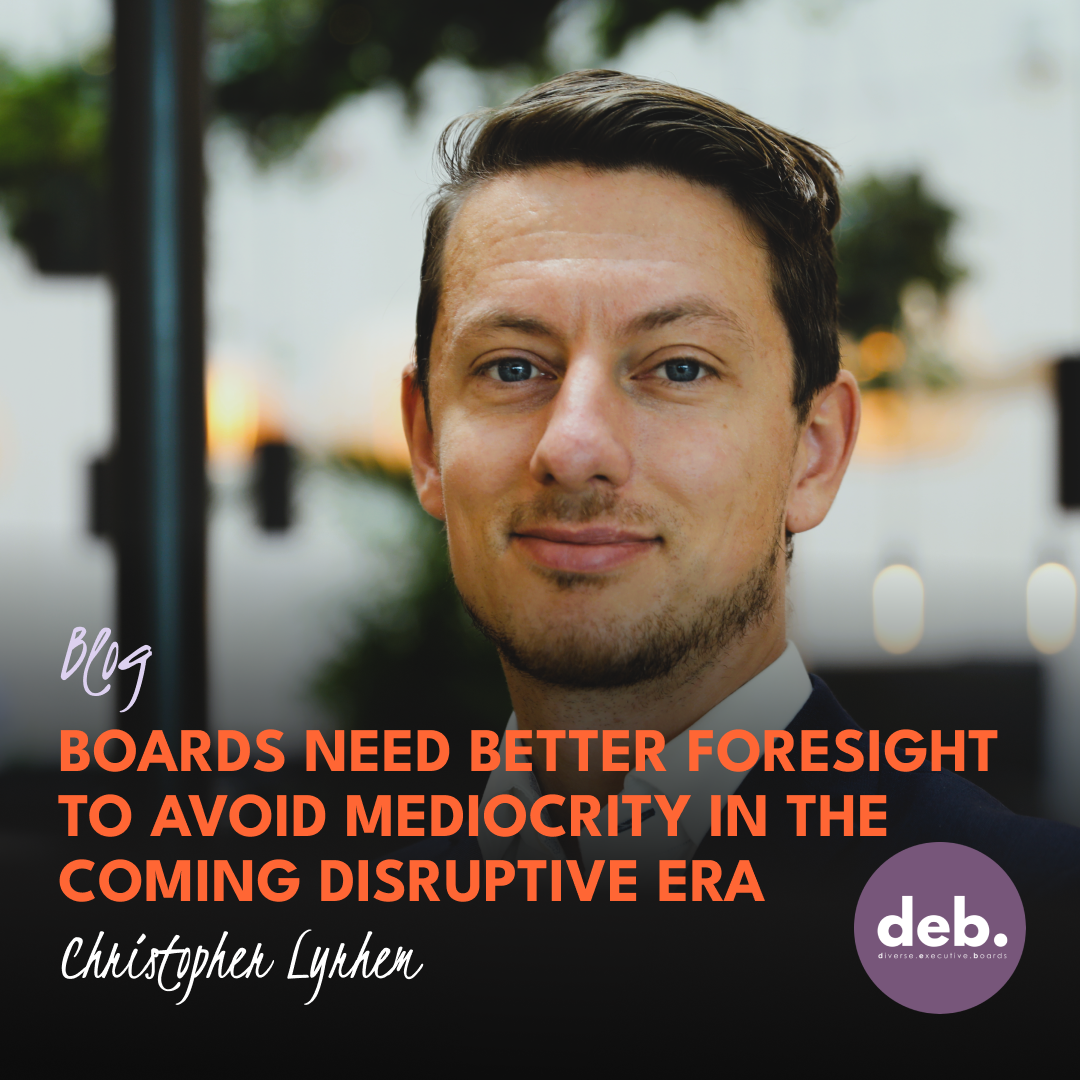
Written by Christopher Lyrhem, Founder & CEO of Disruptivity
“Politics is for the present, but an equation is for eternity”.
This is a quote made by one of the most influential thinkers of human history – Mr. Albert Einstein. Essentially, his message to the world more than a century ago was that after all that’s said and done, an equation of the truth will always prevail. An equation that stands the test of time and transcends short-term politics. An equation that explains the world without preconceived notions and personal agenda.
This quote and meaning has been haunting me over the past few years. In a good way. It has given me the realization that in order to really excel over time, no matter the subject, we all need to apply an equation. And by an equation, I mean a repeatable decision system on proven mechanisms. A system for yourself and team to plug into and rely on over time. A system based on long-term meritocracy, instead of short-term politics.
After analyzing 300+ historical market disruptions spanning the past three centuries, since the Big Bang of the Industrial Revolution, it is clear that our global society is in a permanent mode of perpetual transformation. Something old is always being replaced by something new. The human spirit of exploration is always on, gunning for replacing the way we do things today. Every sector, decade, profession, and product, are constantly on trial for something new. The horse was replaced by the automobile in only a few decades, after being our primary mode of transport for thousands of years. The telegraph was obliterated by the telephone, the transistor obsoleted vacuum tubes, and video streaming took down physical video empires.
But does this have to do with board work? Everything. Because one of the most critical insights from studying history for our global society, and in particular how big transformation come about and impact the game of business, is that traditional business strategy generally does not apply learnings of the past. Instead, it too often relies on internal politics and simple extrapolation of today’s operating model. Short-term incentives rule the game of business. I think some of you, or perhaps even most, recognize this phenomenon. That instead of full-heartedly focusing on building customer value for the long-term, most attention goes to optimizing current operations, not building something new.
And don’t get me wrong; it is critical to maximize one’s performance today. If not, the economic lifeblood seizes flowing. I learned this during my 15 years in equity research and portfolio management. I know the obligations and pressures of meeting deadlines each single day. However, my message is that it is equally important to build something new for the future also. And this is not my subjective opinion. Instead, it is based on the data from the massive study of past market disruptions I mentioned before.
Data that tells us that upwards of 90% of major disruptions are not primarily (to a majority) generated by incumbents. Rather, the newcomers have been the originators of disruption. The newcomers were the Mavericks that defied the collective consensus and experimented until they built something new that replaced the old. They weren’t hindered by complacency, or captives of their own past success, which are prominent major reasons for traditional incumbents being taken down by newcomers. It takes a while, but this is usually the case.
Now, when I dug deeper into these reasons for systemic failure of incumbency and dissected the complacency, I found a widespread inability to judge the incoming paradigm. An inability to seriously take the new thing serious. An inability to prioritize foresight. Because foresight, is the critical process that determines how good you are at understanding how things change. It is the precursor to a successful strategy.
My core message with this article is that foresight has historically been, and still is, an incredibly underappreciated topic and process. Instead of being regarded as a critical component of success, it is regarded as something that doesn’t generate value for the short-term and hence not prioritized enough. But it should. Especially when regarding the countless of companies that has been sucked into the black holes of past disruptions.
In my view, all managements and boards should make foresight, i.e. research about the future, into a mandatory statute written into the constitution of their companies. It should be as prioritized as reconciliation of the P&L. Because when companies of the past have neglected foresight when standing before major prospective disruptions, most of them have made the dire mistake of not looking far enough over the horizon. They have been blinded by short-term cashflow and internal politics.
So, if you’re a board member today, you need to rally your fellow board members to engage the management and make foresight mandatory. It needs to be in the governance framework of your company and be taken seriously. Conducting deep and iterative research about what’s to come – is the only way of truly aligning one’s actions today with the future. The now and the future needs to be aligned in order to maximize the prospects of running a successful strategy for the long-term.
What does “mandatory” look like in practice?
Foresight becomes a standing board agenda item, not an occasional initiative
Management maintains a set of future scenarios that are refreshed on a clear cadence
The company tracks leading indicators and trigger points, not only lagging KPIs
Strategy includes an option portfolio: small, staged investments that buy the right to scale later
The board is explicit about decision rights: what the organization can commit to now, and what must be kept flexible
Ultimately, we’re now entering one of, if not the, most disruptive eras since the start of the Industrial Revolution. AI will transform what types of customer values will prevail, reroute entire supply chains, and reshuffle the competitive landscape. And the velocity of change just keeps speeding up. So, when the business universe moves faster for each year past – you need to as well. This requires a system in place to be able to operate your strategy. You cannot anymore rely on slow strategic processes.
Because “politics is for the present, but an equation is for eternity”.
Build your equation for success now.
Written by Christopher Lyrhem | Founder & CEO of Disruptivity | Linkedin