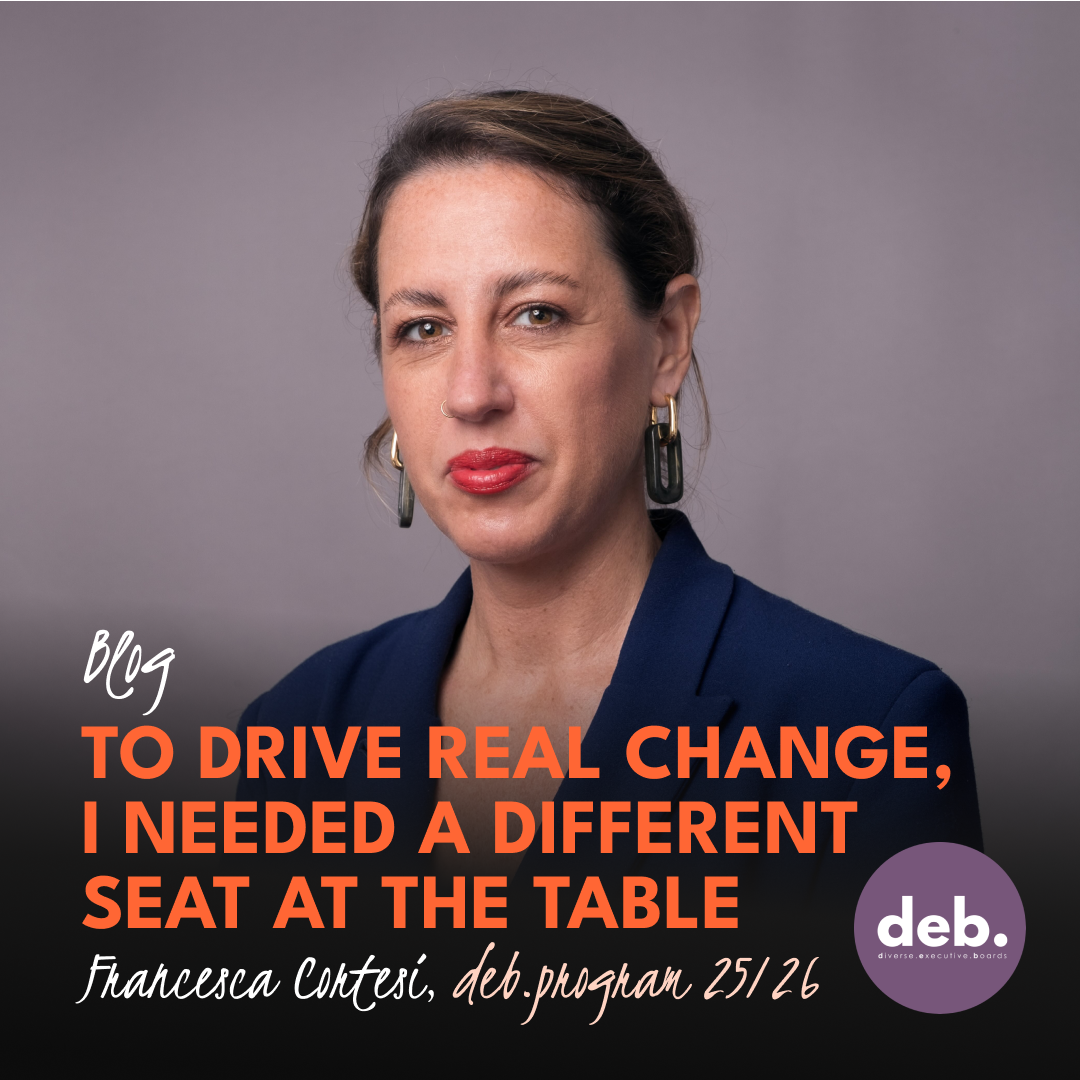
To drive real change, I needed a different seat at the table.
I've been in tech for nearly two decades, the past seven as a C-level executive. I've been part of companies trying to grow with both ambition and purpose, I've led teams, scaled products, sat in countless leadership meetings, and worked closely with boards. But quite frankly, sitting in a board was not something that was top of my mind.
Until one day, at one event, while I was talking about my ambition to have a positive impact in the tech world by being a champion for diversity and sustainable growth, I got hit by a question: "to really make a difference, you should sit in a board."
In a board, really? I had never thought about it.
For a long time board work was in my head a "destination at the end of your career", almost like a recognition for what you have achieved, not a role where you can drive change.
But that question gave me another angle.
I've spent years working with the idea that diverse perspectives fuel better outcomes, and when I reflected on where the biggest decisions get made, the boardroom kept coming up. It is the board that has a sign-off for the strategy, who is responsible for long-term planning, and that defines what the company should pay attention to.
I realized that to have a true impact, I needed a seat at the table, and maybe most importantly I realized that the biggest problem was access.
Have you seen board positions advertised? No? Me neither. And that is because (as I have discovered) the vast majority of board seats in Sweden are appointed through networks. And if you don't already have the network, or previous board experience, you're stuck.
I knew I couldn't just wait for someone to let me in. And as many times in my career, I decided to create my own way and enrolled in the deb. Board Education program.
I saw a certification as the first step to qualify myself to get into the rooms.
What I didn't expect was how much the program would challenge what I thought I understood about board work, and how much of the knowledge I got makes me better in my executive role.
One thing in the program hit me the hardest: board members carry personal liability for the company's finances. Real risk, real consequences. Suddenly all those inputs I had received over the years, the ones that sometimes felt like "nice to have" comments from people dropping in occasionally into operations, made a lot more sense. They weren't just giving opinions, they had their own skin in the game.
It is thanks to deb. that I gained the understanding that changed how I work today, not just how I think about future board roles. I listen differently now, I understand where certain questions come from, why some topics get more attention than others. That knowledge truly made me better at my actual job.
The other gift that came from the program was the connection with the other people around me. Different industries, different experiences, different ways of seeing what a board should do. It opened up my thinking in ways I hadn't anticipated. And it made me realize how much is lost when boardrooms keep pulling from the same pool of people who already know each other.
I came out of it with more than I expected: I understand governance in a way I didn't before, and I have a network that looks different from the one I started with.
I also came out knowing what I bring to a board: nearly two decades of scaling digital businesses across industries and company phases, a track record of leading through uncertainty, and a deep belief in purpose-driven growth. I bring the perspective of someone who sits on the executive side of the table, and now understands the governance side too.
If you are building a board that cares about diverse voices, and is driven by impact, I'd love to talk.
But honestly, even if I never join a board, investing in the deb. program was totally worth it. Because understanding how boards work made me better at working with them. And that's a key worth having either way.
/ Written by Francesca Cortesi | Linkedin